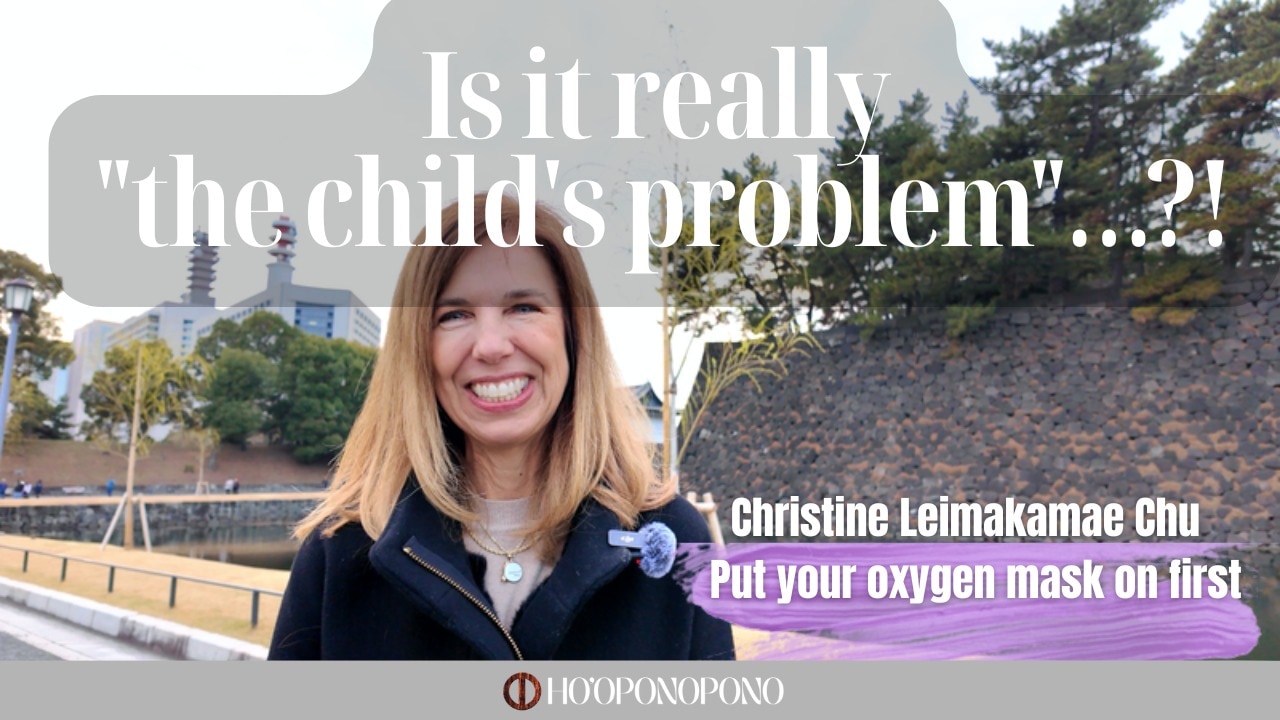
Christine Leimakamae Chu — Put your oxygen mask on first
Walking through Tokyo, we asked Christine about caring for yourself. Through the years of raising children, we tend to give everything to the role and put ourselves last. But Ho’oponopono teaches that filling yourself first is the very way to sustain your family.
Put your oxygen mask on first
The harder we try to be the best parent, the best mother, the more easily we lose ourselves. That, Christine says, is exactly why this practice matters.
“Self-Identity through Ho’oponopono teaches us to look at ourselves first, to care for ourselves first. We can’t care for the family unless we care for ourselves first.”
It’s like the oxygen mask on an airplane: when it comes down, put it on yourself first. Because if you’re not breathing, you can’t help your child breathe.
And yet we’re human, so we think, “No, no, I come last.” Then we reach the end of the day with irritation, and pause: “Why am I irritated at them? Oh — I should look at myself.”
Before getting out of bed
The habit Christine treasures is a small one.
“I try to always talk to my Unihipili first — the inner child within — saying I love you, thank you, before I even get out of bed in the morning.”
Once she’s up, the day starts spinning and gets busy. So, before that. When the conscious mind and the subconscious mind — what we call the “inner family” — are connected, we’re in balance. When the mother and the inner child acknowledge each other, at least we begin the day from a good place.
If a mother doesn’t take care of herself, she falls off balance; she tries hard but grows irritated and exhausted. And children are like sponges — they pick up on it. “If mama’s not happy, no one in the family is happy.”
To care for yourself first is not selfish. It is the way to sustain yourself so that you can help your family.
A vacation from the memories
Christine reminds us that gratitude comes from within.
“We don’t want to push happiness. We just want to quiet the mind, because there’s this lovely experience of quieting one’s mind.”
Everyone tries so hard to be happy and have a happy family — but that’s just a memory replaying. Instead, if we can quiet the mind, it’s simply freedom from all this chaos.
“It’s like a vacation from the memories moving us,” she says. We breathe for a moment, then go out — now in a state of love and peace. The children pick up on it: “Oh, mama’s happy.” And really, mama is just free of the chaos.
When the children leave
In time the children become independent, and parents reach a new stage too. As one major role begins to fade, some feel a kind of emptiness.
“I was very apprehensive of becoming an empty nester — what am I going to do with myself all this time? And wow, this is nice.”
Now she simply cleans with her thoughts of her children and checks in. When they share a concern, she says, “Thank you for letting me know,” and works with herself on it.
Sometimes, being human, she calls out of worry — and the children say, “Mom, back up. Don’t put your anxiety on me.” “That’s your stuff, mom.”
So all we can do is let go of our stuff. To acknowledge “I’m stressed,” “I feel anxiety” is not the problem. The problem is holding onto it — choosing to sit in it.
Ihaleakala says, “Fall in love with your memories.” At least, be okay. Because if we get mad at ourselves for the anxiety, then anxiety and fear pile up, and we’re stuck.
“Thank you, anxiety.” We don’t have to feel it; we don’t have to feel gratitude. We just acknowledge it and apply a cleaning tool: thank you, I love you. That’s all.
We can’t care for the family unless we care for ourselves first. And it’s not selfish.
— Christine Leimakamae Chu
Class & Lecture News
2026/10/17-18: Korea Basic 1 Class
Learn more & sign up →
2026/10/24-25: Japan Basic 1 Class
Learn more & sign up →Turn inward in a private session
Christine Leimakamae Chu's private session is also available →Continue your cleaning journey